THE ORIGIN OF SIGN LANGUAGE
Source
In ancient times, intelligence was closely linked to speech. The deaf, isolated, could not enrich their signed languages and only used simplistic gestures. As a result of not benefiting from education, they were sometimes considered simple-minded.
Some time later, in the 10th century, Odon of Cluny imposed the use of gestures for almost all exchanges, reserving the spoken language for religious discourse only. The expansion of the abbey of Cluny in the tenth century led many communities throughout Europe to adopt the Cluniac sign language or its variants. Later, the rules of absolute silence were relaxed by the Cluniacs, leading to the disappearance of the sign systems, which had become useless.
From the 16th century, deaf painters such as Navarette or Pinturicchio were recognized. Moreover, in Spain, deaf children from the nobility were taught by tutors. One of them, Pedro Ponce de Leon, was interested in existing sign codes such as the manual alphabet and used them to teach these children. Other preceptors focused more on learning to speak.
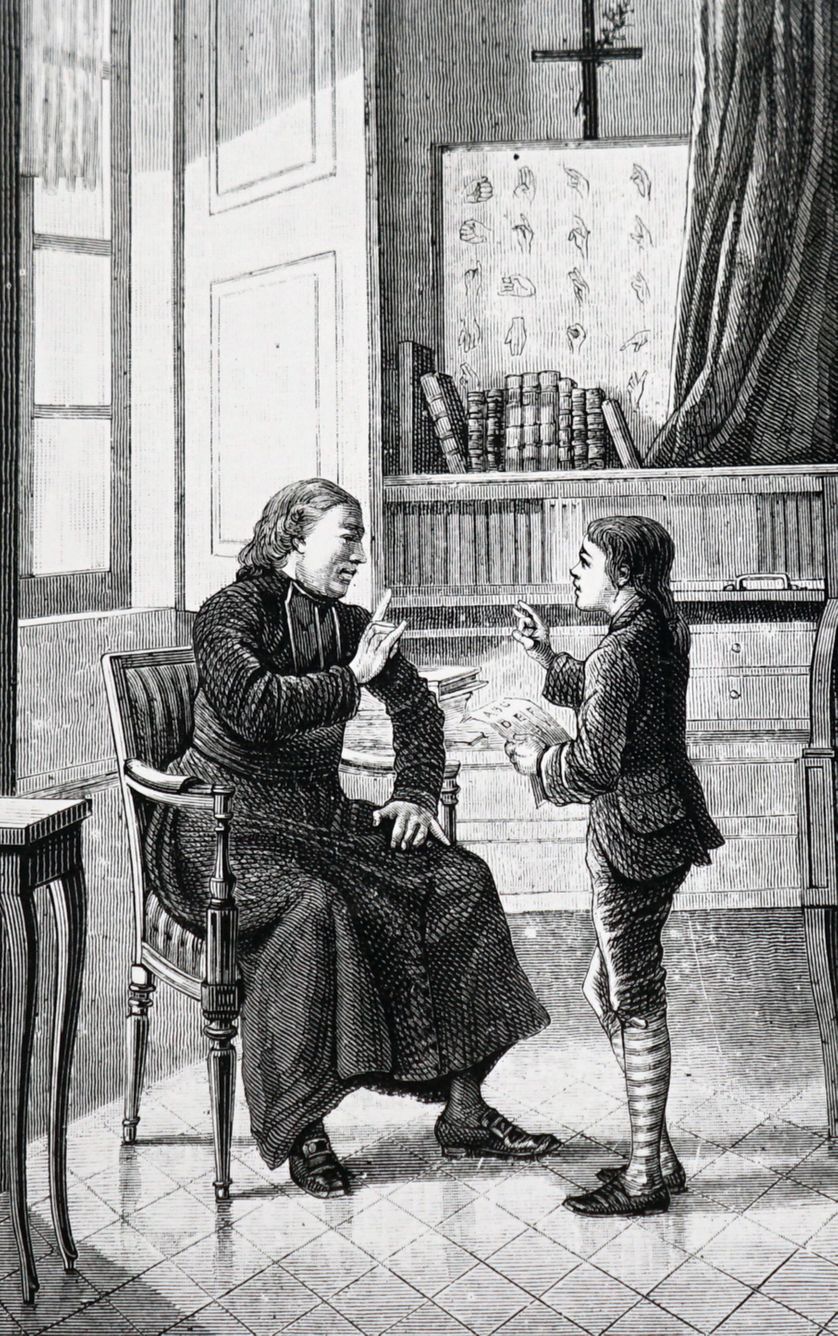
The Abbé de l'Épée was, in 1760, the first hearing person known to be interested in the communication of deaf-mutes. While observing a pair of deaf twins communicating with each other by gestures, he discovered the existence of a sign language. He decided to use this language to teach deaf children. He adapted it by adding grammatical notions specific to French. This is what he calls the "Methodist signs". He gathered deaf children to educate them and opened a real school for the deaf which will become the National Institute for young deaf people, today Institut Saint-Jacques, in Paris.
In the meantime, the "oralist" movement was growing. The "oralists" were thinking that the deaf people must learn to speak to be integrated in the society. The Milan congress in 1880, where the vast majority of the participants were hearing and oralists, decreed that the pure oral method should be preferred. Three reasons were given: sign language is not a real language, it does not allow one to speak about God, signs prevent deaf people from breathing properly, which favors tuberculosis. This preference had dramatic consequences for the deaf. During 100 years the sign language was proscribed, despised and marginalized to the only deaf associations. In the deaf institutes, the students sign in secret.
ANECHOIC CHAMBER

MONASTIC SILENCE

HOW BLIND PEOPLE SEE